Concrete Slab Moisture Testing in Perth: Standards, Values and Cost
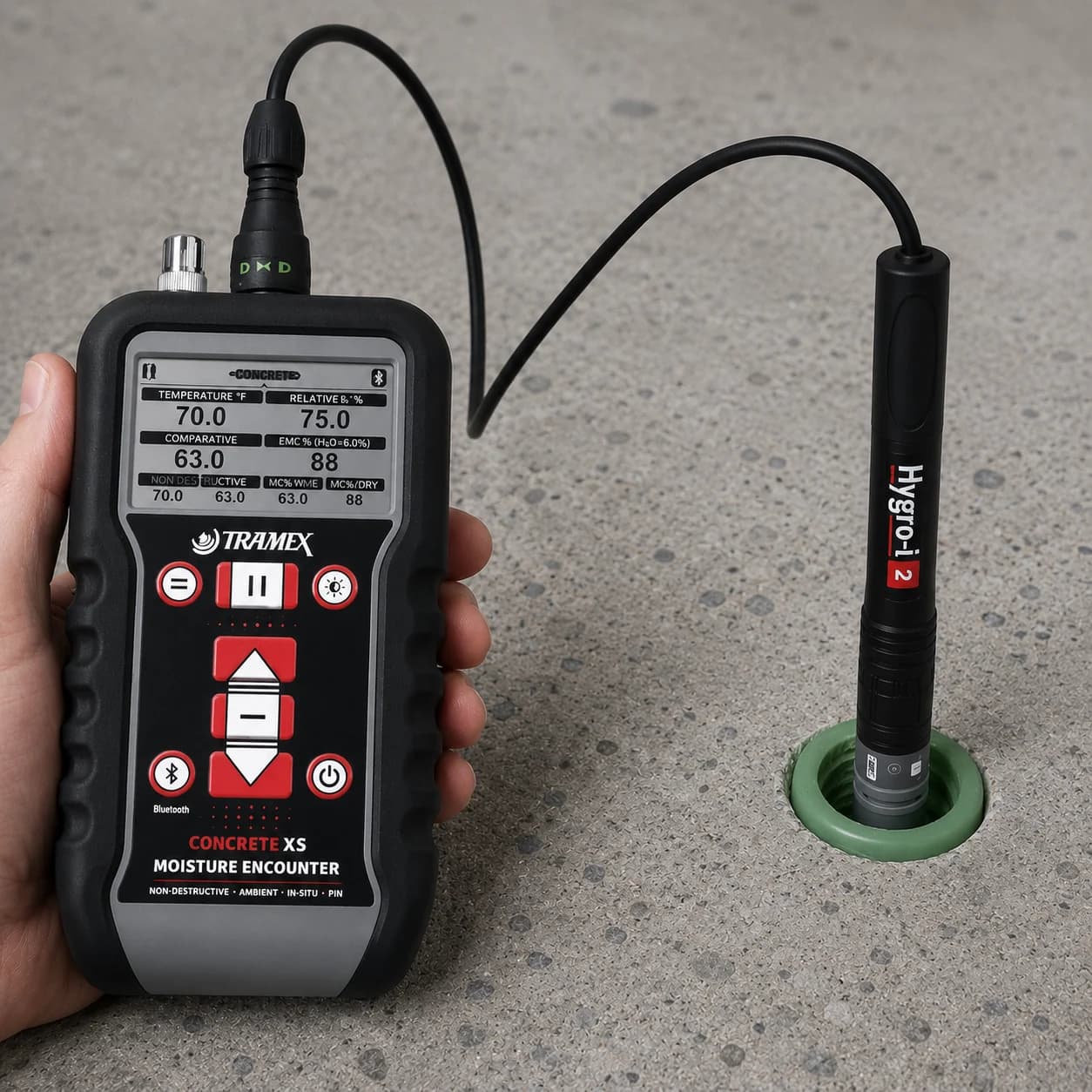
Most new-floor failures we get called to inspect come down to one thing: moisture in the slab. Lay hybrid planks, vinyl, timber or even glue-down carpet over concrete that hasn't dried enough and you get cupping, lifting, bubbling adhesive or a musty smell within months. It's also the quickest way to void your flooring manufacturer's warranty, because almost every warranty requires a documented moisture test first.
That's why we offer in-situ concrete slab moisture testing across Perth, done to the relevant Australian Standards and handed over with a written report you can give your flooring installer, builder or supplier. Here's exactly what we measure, the values you should expect, how we do it, and what it costs.
Why slab moisture testing matters
A new slab can hold construction water for months, and an older slab can keep drawing moisture up from the ground if there's no working vapour barrier beneath it. You can't judge that by touch or by how the surface looks. Hybrid and timber floors are especially sensitive, and a sealed floor laid over a damp slab traps that moisture with nowhere to go. Testing first is the difference between a floor that lasts and a warranty claim that gets rejected.
Which Australian Standards apply
Two standards guide how we do it:
- AS 1884 (Floor coverings, resilient sheet and tiles, installation practices) sets out moisture testing for resilient floors such as vinyl in Australia.
- ASTM F2170 (determining relative humidity in concrete floor slabs using in-situ probes) is the internationally recognised in-situ RH method, and it's what most flooring manufacturers now reference in their warranties.
We test to both, plus a surface pH check, because together they tell you whether the slab is genuinely ready rather than just dry on top.
What we measure: RH and pH
Relative humidity (RH) is measured with probes set down inside the slab, which gives the real internal moisture level rather than a surface reading that dries out and misleads you. Surface pH matters because concrete is alkaline, and a slab that reads too high can chemically break down flooring adhesives. A floor can pass on one of these and fail on the other, so we check both.
The values you should expect
Every flooring product sets its own limits, so the manufacturer's data sheet is always the final word, but as a general guide:
- Relative humidity: most flooring systems require 75% RH or lower. Some vinyls and adhesives allow up to 80 to 85%. Above the limit you need a moisture barrier or a suppression coating.
- Surface pH: a reading of roughly 7 to 9 is the normal acceptable range. Above about 9 to 10, high alkalinity can attack adhesives and needs addressing.
For hybrid flooring specifically, most rigid SPC and WPC manufacturers in Australia ask for in-situ RH at or below 75%, and many require a moisture barrier once the slab reads above that. Hybrid is more forgiving than solid timber, but the warranty still depends on a documented test, so we always check the result against your exact product before anything is laid.
How we test, step by step
- Inspection. We look over the slab for age, visible damp, salt staining and cracks, and confirm the flooring you're installing so we test to the right specification.
- Drill and insert probes. Following ASTM F2170, we drill test holes to 40% of the slab depth for a slab drying from one side and insert sealed RH probe sleeves. The standard sets the number of test locations by area: three for the first 100 m², plus one for each additional 100 m².
- Equilibrate. The sealed probes are left to reach equilibrium with the slab, which ASTM F2170 sets at a minimum of 24 hours. This is why moisture testing needs a short wait rather than an instant number.
- Read with calibrated gear. We take RH and temperature readings with calibrated, in-calibration meters, then run a surface pH test using distilled water and a calibrated method.
- Document. You get a written report with each probe location, depth, the RH, temperature and pH values, the date, and a clear pass or fail against your flooring's requirements. That report is what satisfies the warranty.
What it costs
Moisture testing is a flat $250 per slab for a standard residential job, which includes the in-situ RH probes, the surface pH test and the documented report. Larger commercial slabs that need extra probe locations under ASTM F2170 are quoted on area. Set against the cost of pulling up and replacing a failed floor, or losing a warranty claim, it's cheap insurance.
If the slab is too wet, or cracked
If a slab reads over the limit, we won't lay over it and hope. We'll talk you through the options, usually a moisture barrier or an epoxy moisture-suppression coating that brings the slab back within specification.
For cracks and joints we fill with a two-part epoxy resin rather than a flexible filler. A rigid two-part epoxy bonds hard to the concrete, carries the load and leaves a sound, level surface for the new flooring to sit on, which a soft caulk simply won't do. If the slab also needs flattening, that's covered on our concrete grinding and prep page.
What you can expect
In practice it's a short first visit to place the probes, a wait of at least a day while they equilibrate, then the readings and your report. We keep it tidy, the test holes are small and patched, and you walk away with documentation your builder, installer or flooring supplier can rely on.
Laying new flooring over a slab in Perth?
Get the slab tested before you commit. Send the floor area and the flooring you're installing and we'll book in a moisture test and give you a documented result for your warranty.
Frequently asked questions
How much does concrete slab moisture testing cost in Perth?
A standard residential slab is a flat $250, which includes in-situ relative humidity (RH) probes, surface pH testing and a documented written report. Larger commercial slabs that need extra probe locations under ASTM F2170 are quoted on area. It's a small cost next to replacing a failed floor or losing a warranty claim.
How long does slab moisture testing take?
The in-situ probes need to reach equilibrium with the slab, which ASTM F2170 sets at a minimum of 24 hours, so it isn't an instant reading. In practice that means a short visit to place the probes, then a return the next day to take the readings and produce your report.
What RH level is acceptable for hybrid flooring?
Most hybrid (rigid SPC and WPC) flooring manufacturers in Australia ask for an in-situ RH reading at or below 75%, and many require a moisture barrier once the slab reads above that. Hybrid is more forgiving than solid timber, but the warranty still depends on a documented test, so we always check your specific product's data sheet.
What happens if my slab is too wet?
We won't lay over a slab that fails and hope for the best. If the reading is over the limit we talk you through the options, usually a moisture barrier or an epoxy moisture-suppression coating that brings the slab back within specification before flooring goes down.
Do I really need a moisture test before new flooring?
If you want your flooring manufacturer's warranty to stand, almost always yes. Nearly every hybrid, vinyl, timber and resilient flooring warranty requires a documented slab moisture test, and skipping it is the most common reason new floors fail and claims get rejected.